How to Rewire Your Decision-Making as a Consultant
Article Summary
• Most stuck moments in consulting come down to one thing: still thinking like an employee instead of a business owner.
• The fix is a simple swap — trade employee questions ("Is this good enough?") for business owner questions ("What decision moves this forward?").
• Action beats precision. Consultants get paid to move the work, not to perfect it before starting.
• Before every engagement, ask: "If this fails, what will it be the reason?" — it forces better scoping, pricing, and boundaries up front.
Why It Matters: Shifting from an employee to a business owner mindset.
The fastest way to level up your consulting business is to change the questions you default to.
Employee thinking asks: "What should I do next?"
Business owner thinking asks: "What outcome am I driving toward, and what's the fastest path to get there?"
Below is the 3-part framework I use with clients and in my own business any time I feel myself slipping into employee mode.
1. Identify the trigger moment
Every consultant hits the same sticking points:
• You're waiting for a client to "give direction."
• You're hesitating to send a proposal because you want it to be perfect.
• You're overthinking a price because you're subconsciously converting it to a salary.
• You're doing extra work to "prove yourself," even though nobody asked.
These moments are signals.
The moment you feel stuck, ask:
"Am I acting like an employee or a business owner right now?"
Most people instantly know the answer.
2. Replace the employee question with the business owner question
Here's the swap that changes everything:
Employee question:
"Is this good enough? Will they approve it?"
Business owner question:
"What decision moves this forward?"
Employee question:
"What will they think of me?"
Business owner question:
"What outcome am I responsible for creating?"
Employee question:
"What's the safest option?"
Business owner question:
"What's the most effective option?"
Your decisions get faster. Your work gets sharper. And your value becomes more obvious.
3. Act before you feel ready
Employees are rewarded for polish. Consultants are rewarded for momentum.
You don't get paid to think about the work. You get paid to move the work.
A simple rule: Action beats precision. Precision comes later.
The more you practice acting before your brain offers approval, the more you'll behave like someone who runs a business rather than someone trying not to get in trouble.
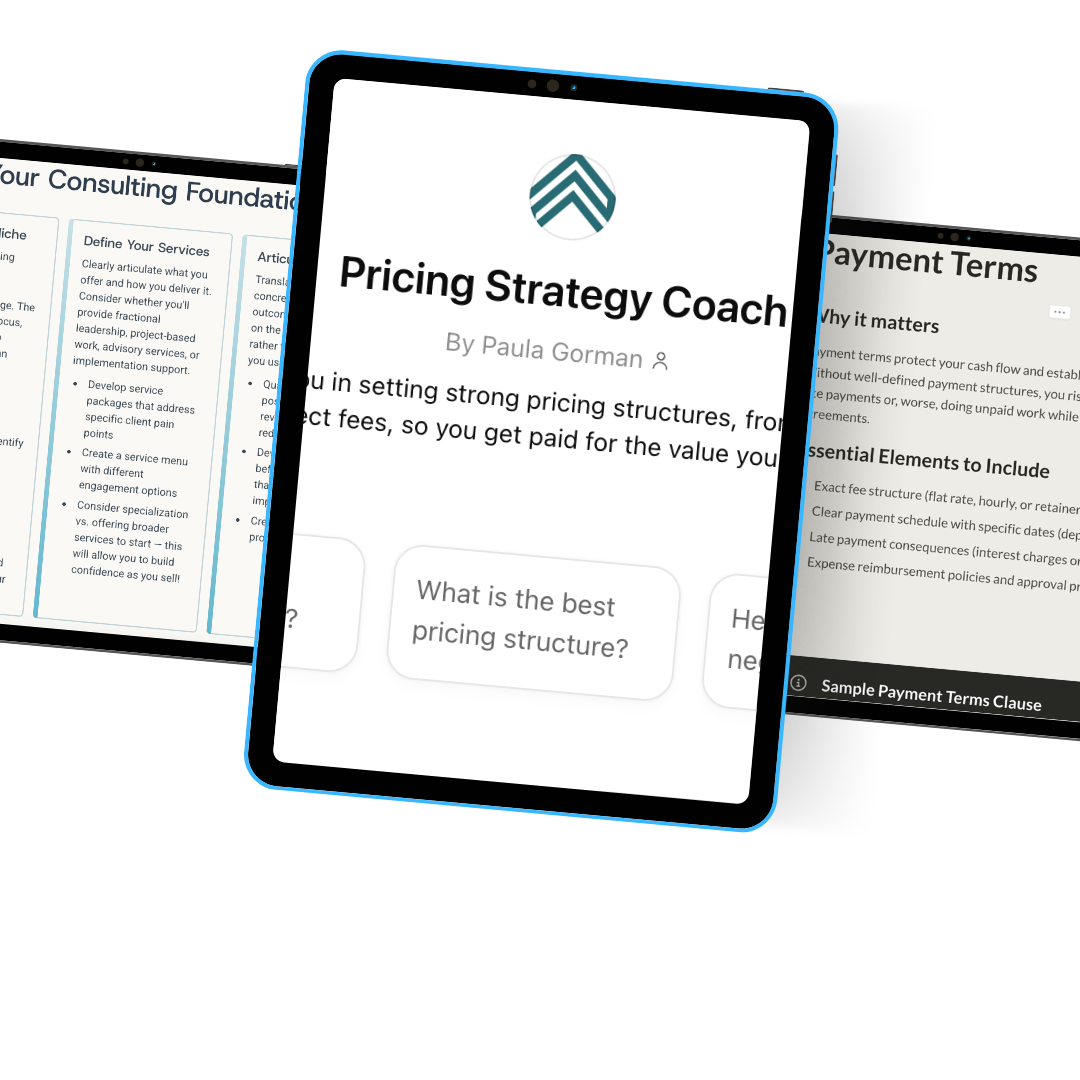
Ready to get serious about becoming an independent consultant, but not sure where to start?
If you're stuck trying to figuring out the foundational business owner questions — pricing, positioning, or scope — that's exactly what the Consulting Business Bundle is built for.
The question I ask before every engagement
Any time I'm scoping a project, looking at a messy problem, or deciding whether a client is a fit, I ask:
"If this engagement fails, what will be the reason?"
There are always patterns:
• unclear decision-makers
• lack of access to systems
• unrealistic timelines
• clients who don't actually prioritize the outcome
• work that's technically "consulting" but functionally employee replacement
This question forces me into business owner mode immediately.
It pushes me to:
• set better boundaries
• design a scope that protects both sides
• price based on risk and outcomes
• get clarity before anything becomes a problem
Most new consultants skip this entirely, then wonder why their work feels shaky.
A moment that snapped me out of employee mode
Early in my consulting business, I took on a project where I basically became an invisible internal team member. I was doing a ton of work no one saw, trying to "look valuable," and constantly double-checking things that didn't matter.
At one point, I realized I was looking to them to tell me how to fix the problem rather than taking ownership and fixing it myself.
I realized I was waiting for permission. Waiting to be evaluated. Waiting to be told I was "doing it right."
It was pure employee conditioning.
The next day, I rewrote the scope, took ownership of the project plan, made recommendations without asking for approval, and stopped performing like a worker.
Everything changed:
• the work got easier
• the results got better
• my pricing went up
• and I stopped feeling like I needed to "earn" my place
If you're stuck, here's where to focus this week
A simple exercise:
1. Think about one place where you're hesitating.
2. Write down the employee question you're stuck on.
3. Rewrite it into a business owner question.
4. Take the action that aligns with the owner version of you.
FAQ
What's the difference between "employee thinking" and "business owner thinking" in consulting?
Employee thinking asks what to do next and waits for approval. Business owner thinking asks what outcome you're driving toward and takes ownership of getting there, without waiting to be told you're doing it right.
How do I know when I've slipped into employee mode?
Common signals include waiting for a client to give direction, over-polishing a proposal before sending it, second-guessing a price because you're mentally converting it to a salary, or doing unrequested work to "prove yourself."
What question should I ask before taking on a new consulting engagement?
Ask, "If this engagement fails, what will it be because of?" It surfaces risks like unclear decision-makers, unrealistic timelines, or scope that's really just employee replacement — before they become problems.
Why does "action beats precision" matter for consultants?
Consultants are paid to move the work forward, not to perfect it before starting. Waiting for a feeling of readiness keeps you in employee mode; taking action builds the momentum that business owners are rewarded for.