If You Want $20K+ Consulting Months, Your Pricing Model Matters
Article Summary
How you structure your consulting engagements can have a major impact on your income, capacity, and freedom. In this article, I break down the differences between freelance, consulting, and fractional work, and explain how shifting from hourly work to fixed-fee projects and eventually retainers helped me increase my revenue-to-capacity ratio. I also share my own pricing evolution to show how you can strategically evolve your business as you gain experience, expertise, and confidence.
How to Structure Your Consulting Work to Increase Your Income
In my experience, your income as a consultant is aligned with the type of work you do and how you structure it. Let’s start first with a quick breakdown of the differences between freelance, consulting, and fractional work.
Freelance
Typically, more tactical work (think project management, web design, copywriting) or when the scope of work is less defined. Often paid at an hourly rate given the tactical nature and/or lack of defined scope.
Consulting
Usually brought in for a particular project and/or for work that is scoped with deliverables, milestones, and a timeline. In this case, a project-based/fixed fee works well.
Fractional Leadership
This is a newer and growing term and function.
Think of fractional work as part-time leadership — when a startup or small organization doesn’t need a full-time C-suite executive, but they do need expertise and some dedicated time.
A retainer model/retained fee is the way to go here. You commit to a certain number of days or hours per month or week for a set rate.
Fractional work is where the big bucks come in.
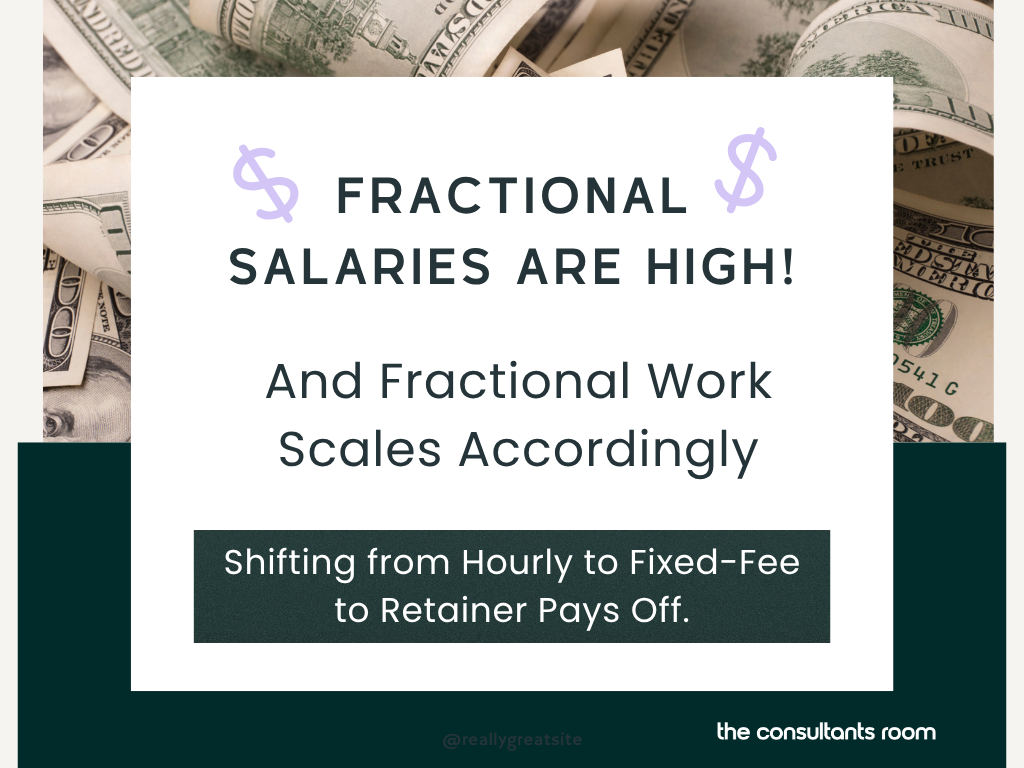
Executive salaries are... HIGH... and fractional work scales accordingly. This is where those $20,000–$30,000 months come in with as few as one engagement.
Yes, one.
Your Consulting Model Can Evolve
Now that we have an understanding of the primary structures, I want to highlight the fact that we can evolve as our business grows.
There is nothing wrong with hourly, and it works very well for some kinds of work. However, an eventual shift to consulting or fractional may be a goal to unlock more income.
Not only can you evolve how you structure your engagements as you obtain new clients, there is a way to shift existing clients, too.
I’ll share my pricing evolution with my business so you can see this in practice, rather than theory.
My Story
I started with my first client on an hourly basis.
I was a newbie to independent consulting and, while our scope was vaguely defined, I had no clue how much time I needed to get it done.
While working on that initial project, I identified a couple of other solutions to improve the company’s operational infrastructure. I presented solutions and a proposal for the work.
That proposal was a fixed fee.
They did ask me why a set fee rather than hourly, and I explained that since we had clear deliverables and a timeline, it made the most sense.
They signed with no issue.
I did a couple more projects for them on a fixed fee before shifting to a retained fee.
I had decided that I wanted to work exclusively on retainer going forward across all of my clients. I was now two years into my consulting journey at this point, and I wanted to achieve the best revenue-to-capacity ratio.
I presented the idea to my client with the framing that since I had worked with them for two years and we’d accomplished a lot, I would serve as an operations catch-all. I laid out the type of work that would be included and excluded, in which case it made the most sense to set a number of hours per month with a flat fee.
They were amenable as I walked them through the impact I’d had to date, as well as the benefits that structure had for them.
They have me reserved for those hours each month, and I have deep expertise in their business and great rapport with the team.
And here we are, three years strong with our relationship.
The Potential Is Real
If you are just starting out in your consulting journey — or are even just noodling on the idea of it — I hope you are encouraged by the potential.
There is freedom and control to be had, as well as a salary with no cap.
If you’re serious about structuring your contracts the right way, grab my Contract & Pricing Playbook; it’s built for exactly this.
I am rooting for you!
FAQ
How do I know whether I should charge hourly, use a fixed fee, or work on retainer?
It depends on the type of work you’re doing. Hourly pricing can make sense when the scope is less defined or the work is more tactical. Fixed fees work well when you have clear deliverables, milestones, and a timeline. Retainers are a strong fit when you’re providing ongoing expertise or fractional leadership.
Is there anything wrong with charging hourly as a consultant?
Not at all. Hourly pricing can work very well for certain types of work, especially when you’re just getting started or the scope is difficult to define. You don’t need to abandon hourly pricing before you’re ready.
Can I move an existing client from hourly to a fixed fee or retainer?
Absolutely. I did exactly this with one of my own clients. As your expertise grows and you build a stronger relationship with a client, you can introduce a new structure that better reflects the value you provide.
When should I consider moving to a retainer?
A retainer can make sense when you have ongoing demand from a client and a clear understanding of the type and amount of support they need. It can also help you create more predictable revenue and improve your revenue-to-capacity ratio.
What is fractional leadership?
Fractional leadership is essentially part-time leadership. A company may not need a full-time executive, but they still need experienced leadership and dedicated support. You commit to a defined number of hours or days per month or week for a set fee.
Can fractional consulting really increase my income?
It can. Because fractional work is tied to specialized expertise and leadership rather than simply hours worked, the economics can be significantly different from traditional hourly work. The key is having the right expertise, positioning, clients, and engagement structure.
Do I need to start with consulting or fractional work?
No. You can start wherever makes sense for your experience and the work you’re offering. Your business model can evolve over time as you gain expertise, build your client base, and become more confident in the value you provide.
How can I get better at pricing and structuring my consulting contracts?
Start by looking at the type of work you’re doing, the value you’re creating, and how much capacity you want to dedicate to each client. From there, choose an engagement structure that supports both your client’s needs and the business you want to build.