How to Nurture Relationships Without Turning Every Conversation Into a Transaction
Article Summary
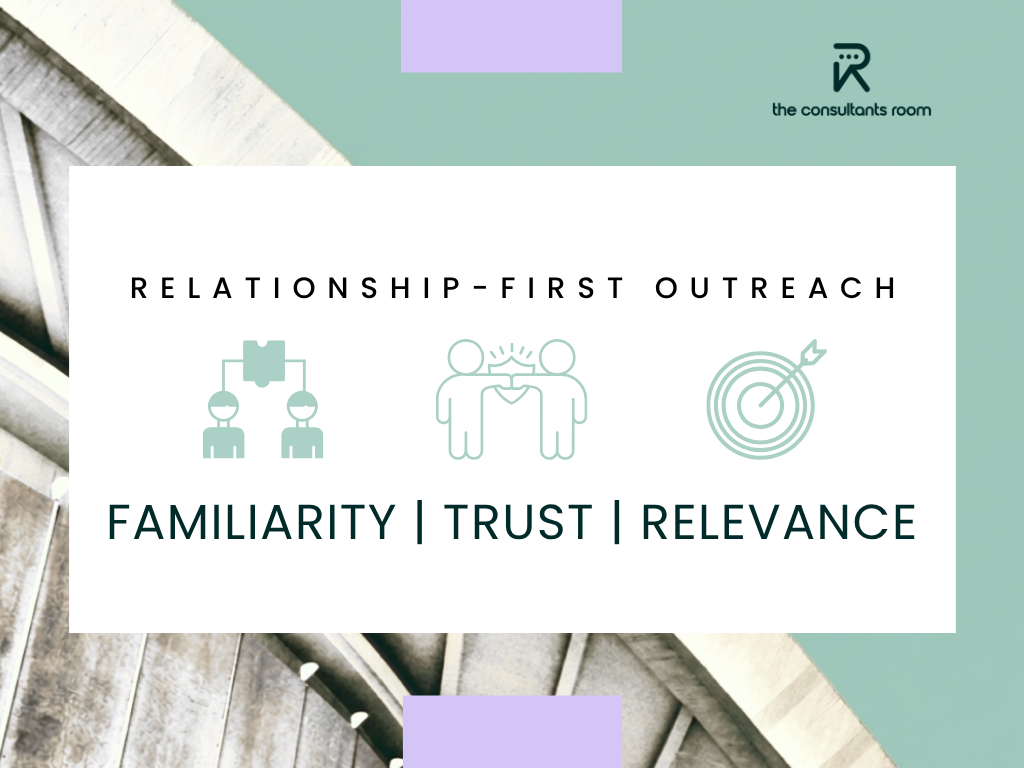
Consulting outreach doesn’t need to follow a traditional sales model. Instead of moving every conversation toward a pitch or close, focus on building familiarity, trust, and relevance. Reconnect without an agenda, get curious about what’s happening in the other person’s world, recognize patterns, and introduce your expertise only when it’s genuinely useful.
The goal isn’t immediate conversion. It’s creating relationships that naturally lead to opportunities when the timing is right.
Want Clients? Build Relationships First.
If you’re coming from corporate, you’re probably used to a sales model that looks something like this:
discovery → pitch → close
And in corporate outreach, this model works pretty good (most of the time). But consulting is all about relationships, and in this environment, a pitch-forward model just doesn’t work. So what do you do instead? You ditch the sales first approach and go all in on trying to not sell. But then you end up with no structure, no forward momentum, and a lead that has no idea why you reached out in the first place. This is also a model that doesn’t quite hit the mark.
What you need instead is a relationship-first outreach flow that still creates momentum, just without pressure.
A Relationship-First Outreach Flow Prioritizes Connection, Curiosity, & Relevance
1. Reconnect Without an Agenda
Your goal at the start is presence.
Open simply:
“I realized it’s been a while and wanted to properly catch up.”
“I’ve been curious what you’ve been working on lately.”
“You came to mind and I wanted to reconnect.”
2. Get Curious About Their World
This is where trust actually forms.
Ask open, non-performative questions:
“What’s taking up most of your energy right now?”
“What feels harder than it should?”
“What’s changed for you in the last six months?”
Then stop talking.
Curiosity is not a tactic. It’s a signal that you’re paying attention.
3. Validate Patterns You’re Seeing
This is the bridge most people skip.
Try:
“I’ve been hearing this come up a lot. Is that true for you too?”
“This reminds me of what a few other teams are dealing with. Does that resonate?”
“I might be off, but it sounds like the real issue is ___.”
Being accurately reflective builds more credibility than listing credentials.
4. Invite Your Work In. Don’t Insert It.
There will be a moment where your experience is relevant. Wait for it.
Then show up gently:
“This overlaps with the kind of work I’ve been doing lately.”
“If it’s useful, I can share how I’ve seen others approach this.”
“Happy to talk through what support could look like. No pressure either way.”
The key phrase is if it’s useful and you have to mean it.
5. Close With Continuity, Not Conversion
A good outreach conversation doesn’t end with a proposal. It ends with a thread you can pick up later.
Examples:
“Want me to send over that article we mentioned?”
“Let’s check back in after your next planning cycle.”
“I’ll keep you posted if I see something relevant.”
This keeps the relationship alive without forcing momentum that isn’t there.
Why This Works Long-Term
Relationship-first outreach can feel slower, but it compounds because:
People remember how you made them feel.
You stay top of mind without hovering.
Your name comes up when timing does align.
Most consulting work doesn’t come from perfectly timed pitches.
It comes from familiarity + trust + relevance converging.
Sales doesn’t disappear in this model, it just stops being awkward.
Final Thought
If your outreach feels heavy, you’re probably trying to make something happen too soon.
Be human.
Be curious.
Keep the thread alive.
Your time will come.
FAQ
What is relationship-first outreach in consulting?
Relationship-first outreach is an approach to business development that prioritizes genuine connection, curiosity, and relevance over immediately pitching services. The goal is to build and maintain relationships so that opportunities can develop naturally when a need and the consultant’s expertise align.
How is relationship-first outreach different from traditional sales?
Traditional sales often follows a structured progression from discovery to pitch to close. Relationship-first outreach doesn’t assume every conversation needs to become a sales opportunity. Instead, it focuses on understanding the other person’s needs, offering relevant expertise when appropriate, and maintaining the relationship over time.
How do consultants reconnect with former colleagues or contacts without sounding salesy?
Start without a sales agenda. Ask what they’ve been working on, what has changed, or what challenges are taking up their attention. If your expertise becomes relevant during the conversation, you can offer to share your perspective without immediately turning the conversation into a pitch.
When should a consultant bring up their services during an outreach conversation?
Bring up your work when there is a natural connection between the person’s needs and your experience. Rather than inserting a sales pitch, explain how your work relates to the challenge they described and offer to share ideas or discuss potential support if it would be useful.
What should happen after a consulting networking conversation?
Create a natural reason to stay connected. Send a useful resource, follow up after an upcoming milestone, share something relevant when you encounter it, or simply reconnect later. The objective is continuity rather than forcing every conversation toward an immediate proposal.